مكتب الجودة وتقييم الأداء

المزيد ...

حول مكتب الجودة وتقييم الأداء

حقائق حول مكتب الجودة وتقييم الأداء

نفتخر بما نقدمه للمجتمع والعالم

12

المنشورات العلمية

2

هيئة التدريس

منشورات مختارة

بعض المنشورات التي تم نشرها في مكتب الجودة وتقييم الأداء

Covid-19 Vaccination Hesitancy: Preliminary Questionnaire Survey of Knowledge and Attitudes in Libya

Background: The pre-vaccination survey is considered an important tool for assessing and evaluating knowledge, attitudes and determine vaccine hesitancy. Throughout many decades the world had faced a challenge in fighting against the endemic, epidemic, and pandemic diseases that have been emerging and re-emerging special those that constitute a great potential risk on humanity’s life. Still, after more than one year and half of scientific milestones of COVID-19 pandemic, there are many countries scarifying and struggling to mitigate the impacts of SARS-CoV-2 among their societies. Objectives: Our study was conduct to address, assessing and evaluate COVID-19 vaccine literacy (VL) prior to and during the vaccination campaign in Libya. Material and Methods: The cross-sectional questionnaire survey was conducted during April 2021 one week prior COVID-19 vaccination campaign in Libya. All relevant data was obtained and collected by online and face-to-face interview. The sampling method with an online Microsoft form questionnaire resulted in collecting only 33 valid questionnaires. Further, the survey carried out also during vaccination campaign however, any participants who had already taken the COVID-19 vaccine were not indorsed in questionnaire survey. Results: A total of 243 participants were involved in this study. The overall response rate (45.6%). This study enrolled (58.8%) and (41.2%) of participants from male and female respectively. Considering the age classes, the results revealed that (35%, 18-30 year), (43.6%, 31-50 year), (18.5%, 51-65 year) and (>65 year, 2.9%). The results revealed that, 29.2% (95% Confidence Interval (CI): 25%-33.44%) of the respondents were confirmed or suspected COVID-19 infection, while and 70.8% (95% CI: 66.56%-75%) participants were not sure if they had contracted the virus. Regarding the recurrent COVID-19 infection, our questionnaire survey reported that, at least 5.8% (95% CI: 3.60%-7.92%) of the respondents had got infected twice by SRAS-CoV-2. Regarding the currently available COVID-19 vaccines (Sputnik V, AstraZeneca and Sinovac) in the country, the vast majority (43.2%) of the participants, they would like to prefer the Sputnik V, followed by (19.3%) AstraZeneca and (2.5%) Sinovac vaccines, while (35%) of the respondents refused to be vaccinated by three of these vaccines that have been provided by the Libyan healthy authorities under the supervision of NCDC. A proximately 33% (95% CI: 28.56%-37.28%) of the respondents refused to be vaccinated due to mistrust in the vaccine safety. Clearly, the vaccine safety was the main cause for the refuse and delay time of the vaccination from the most of the population. Conclusion: Our study highlights that, the vaccine hesitancy is underestimated issue in Libya, and clearly there is misleading and misinformation about SARS-CoV-2 from unauthorized media sources. According to the metadata analysis of high efficacy, safety and successes of COVID-19 vaccines for mitigate and minimize both the case fatality rate (CFT) and transmission rate across the entire of the global, still there is a controversies around potential safety concerns of the COVID-19 vaccines. Urgently, the Libyan healthy authority needs to enforce the public health education about vaccine safety, and Libyan healthy authorities should be implement an effective vaccination strategies that complement with international standard criteria for the vaccination policy to improve the vaccination efficacy and the vaccine coverage rate. Consequently, The Libya national deployment and vaccination plan for the COVID-19 vaccine should implement National Immunization Technical Advisory Group (NITAG) in every municipality for collecting and processing information, and producing periodic reports during COVID-19 vaccination campaign.
Abdusalam Sharef Abdusalam Mahmoud(6-2021)
Publisher's website

Rift Valley fever virus: a serological survey in Libyan ruminants

A serological survey was carried out in Libya to investigate the circulation of Rift Valley fever virus (RVFV) among domestic ruminants. A total of 857 serum samples were collected from year 2015 to 2016 in eleven provinces of Libya belonging to five branches of the country. Samples were tested for RVFV antibodies using a competitive EnzymeLinked Immunosorbent Assay (c-ELISA). Antibodies specific for RVFV were not detected in any of the 857 samples. However, a statistical analysis was carried out to assess the maximum expected number of infected animals and the maximum expected prevalence of RVFV among Libyan ruminants’ populations according to the sampled population. The overall maximum expected prevalence was estimated to be 1.8% for cattle and 0.4% for small ruminants. Results seem to exclude the circulation of RVFV, however, a surveillance plan should be implemented in areas at risk of RVFV introduction. arabic 10 English 55
Abdusalam Sharef Abdusalam Mahmoud, (6-2018)
Publisher's website

Seroprevalence and potential risk factors associated with Toxoplasma gondii infection in women from Tripoli, Libya

Aims: To determine the seroprevalence of Toxoplasma gondii (T. gondii) in women from Aljalla Maternity and Gynaecology Hospital (AMGH) and to evaluate the association between the infection and potential risk factors. Methods: A cross-sectional study was conducted at AMGH in Tripoli during the year 2012. Data on potential risk factors were collected by a structured questionnaire and results of the test. The output data of questionnaire were used to assess potential risk factors for positive outcome. All sera (n = 500) was screened against ToxoG, by using the Vidas machine automated enzyme-linked florescent immunoassay. The association between the outcome variables and its potential risk factors were screened in a multivariate analysis. A p-value < 0.05 was considered to be significant. Results: The overall seroprevalence was estimated to be 50.8% with 95% confidence interval (CI) (46.42%–55.18%). The results revealed that T. gondii infection is highly prevalent, and eating habits (consuming raw meat and/or raw vegetables or fruits) were highly significant associated in multivariable analysis. Expectedly, a significantly [odds ratio (OR):1.712; p =
Abdusalam Sharef Abdusalam Mahmoud(1-2019)
Publisher's website

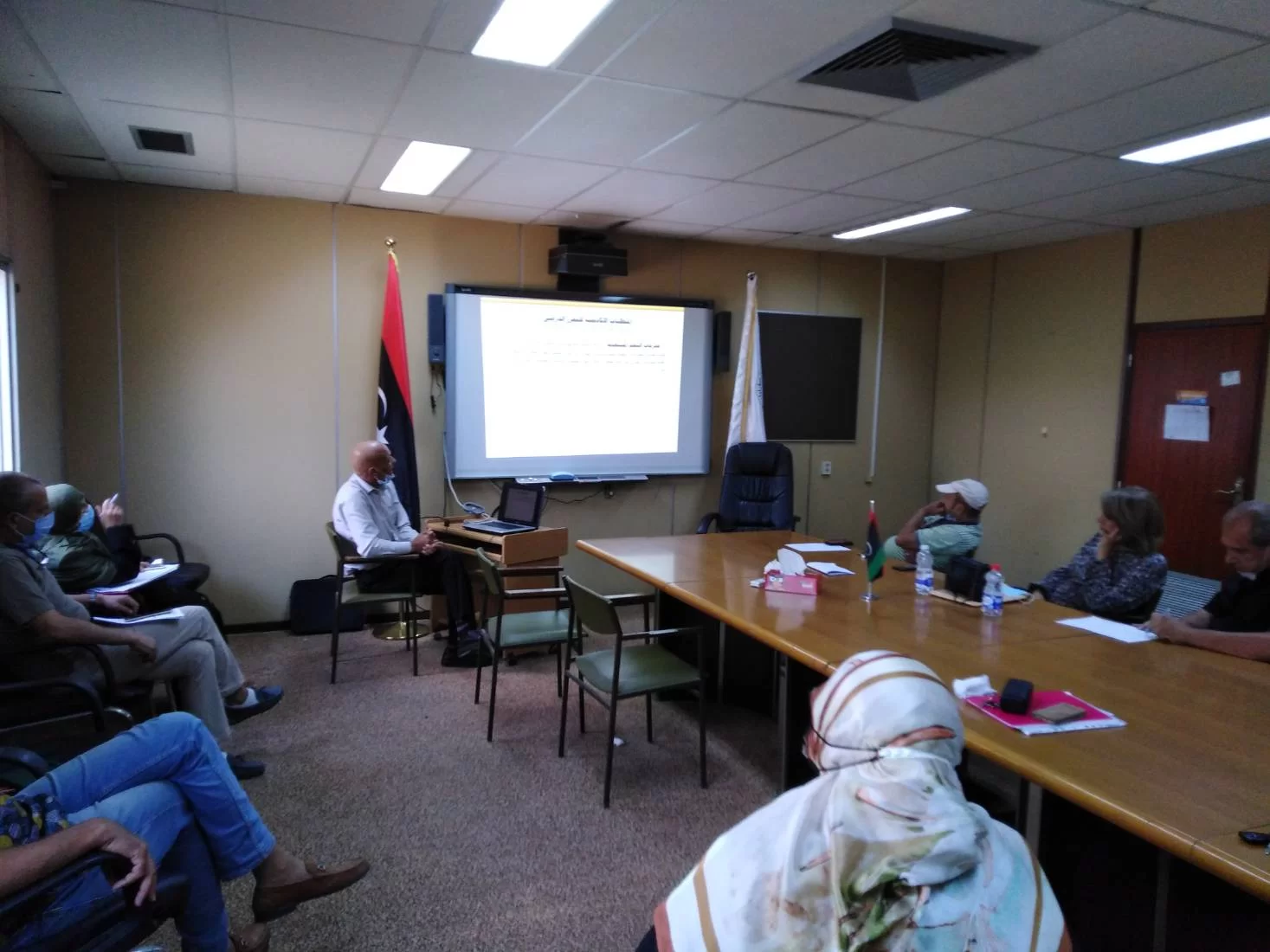
مكتب الجودة وتقييم الأداء في صور

الالبومات الخاصة بفعاليات مكتب الجودة وتقييم الأداء